
 Español
Budget friendly composite decking: Practical Applications, Selection, Performance, and
News-Content
- 1 What Budget Friendly Really Means
- 2 What Actually Drives the Price of a Board
- 3 Hollow Profiles: Where the Savings Usually Sit
- 4 The Costs That Live Around the Boards
- 5 Six Ways to Cut the Number Without Cutting Quality
- 6 Where Budget Decks Go Wrong
- 7 How a Deck Budget Actually Splits
- 8 Buying Direct: Questions Worth Asking Before You Commit
Most people who search for budget friendly composite decking are not chasing the cheapest board on the pallet. They want a deck that looks good, stands up to the weather, and does not wreck the household budget. That is a slightly different question, and a much more useful one. After eight years of shipping composite decking into more than 25 countries, we have watched the same pattern repeat: the buyers who spend least overall are rarely the ones who paid the lowest price per board. They are the ones who matched the right board to the right job.
What Budget Friendly Really Means
Composite decking retail pricing in the US market commonly runs from roughly $1.50 to $5.30 per linear foot, and that spread is driven by construction, not marketing. Two boards can look almost identical on a sample rack and still differ by more than 200% in price, because one is a hollow profile with a thin surface treatment while the other is a solid board wrapped in a thick co-extruded cap.
So budget friendly is not a polite word for cheap. It means your money lands on the parts of the board that do real work: the polymer blend, the surface layer, the wall thickness, the fastening system. Everything else is detail you can negotiate.
What Actually Drives the Price of a Board
Four factors move the number more than anything else: profile, surface treatment, polymer content, and order volume. The table below is the shortcut version we use whenever a customer asks why one quote came back so much lower than another.
| Board type | Price position | What you are paying for | Best fit |
|---|---|---|---|
| Classic hollow | Lowest | Less material per metre, lighter freight, hidden clip system | Standard residential decks, rentals, budget renovations |
| Classic solid | Mid | Denser profile, stronger fastener hold, more mass underfoot | High-traffic family decks and ground-level terraces |
| Deep embossed | Mid to upper | Extra surface texturing and slip resistance | Pool surrounds, shaded or damp areas |
| Half co-extrusion | Between classic and full | Capped wear surface on a classic core | Where appearance matters but the budget is tight |
| Full co-extrusion | Highest | Four-sided protective cap, strongest colour and stain resistance | Coastal, high-UV and commercial projects |
For the wider picture, our full material comparison for outdoor decking sets composite against timber, PVC and aluminium on both purchase price and ten-year cost.
Hollow Profiles: Where the Savings Usually Sit
Hollow boards use meaningfully less material per metre than solid ones, and because they weigh less, freight and handling come down with them. On a standard residential deck that difference alone is often the single largest saving available without touching quality. The trade-off is mass: a hollow board feels slightly different underfoot, which matters little on a raised private deck and rather more on a busy walkway.
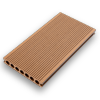
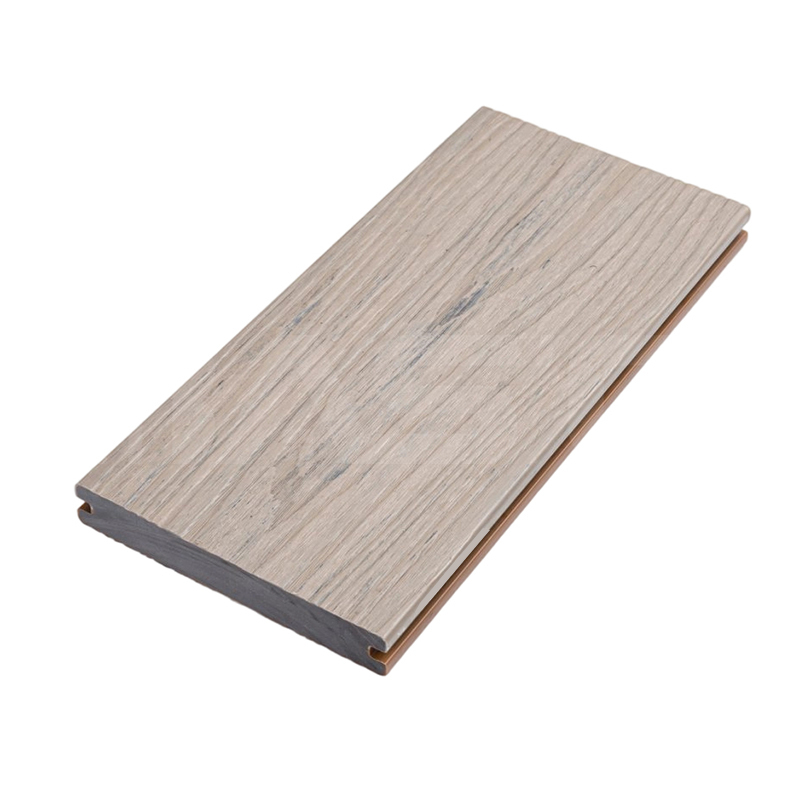
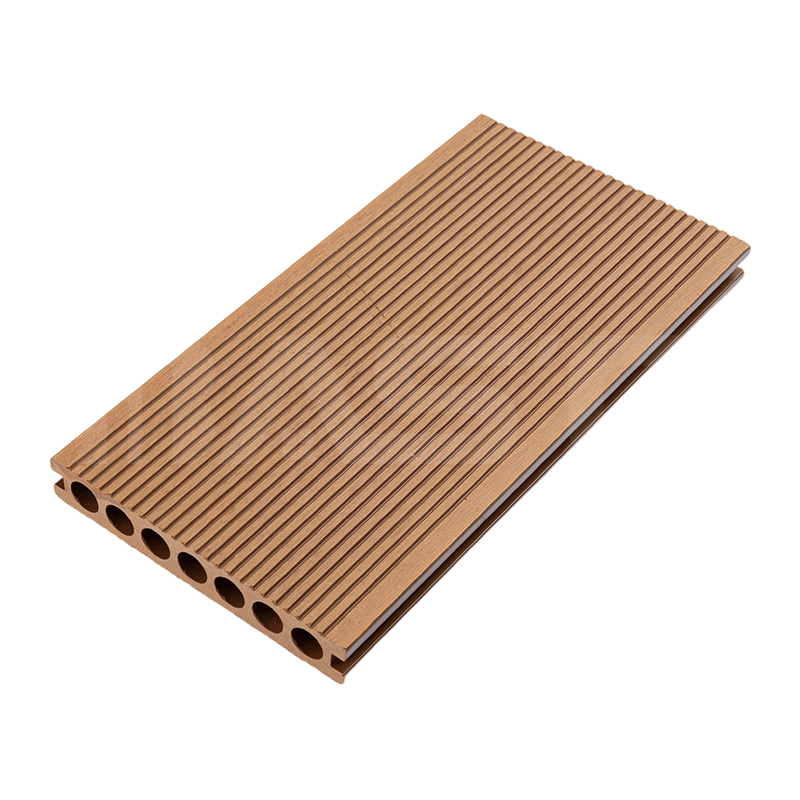 Hollow WPC Composite Decking Board, 150 x 23 mmLightweight hollow WPC decking board that reduces material and freight costs; suited to raised private decks where underfoot feel matters less than budget savings.View Product →
Hollow does not mean fragile. A well-made hollow profile with a proper cap and correct joist spacing will happily carry a family barbecue for fifteen years. What we would not do is put the cheapest hollow board around a swimming pool or on a west-facing roof terrace, where UV and standing water do the real damage. In those spots the extra 20% for a capped board pays for itself in colour retention alone.
Solid boards, by contrast, hold fasteners better and shrug off heavier foot traffic. If the deck is going to become the main outdoor room of the house, solid or half co-extrusion is usually the smarter long-term buy.
The Costs That Live Around the Boards
Boards are the visible part of the budget, but the small parts decide whether a project runs over. Clips, joists, edge trim and pedestals are where first-time buyers get caught, because they price the decking and forget everything underneath it.
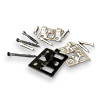
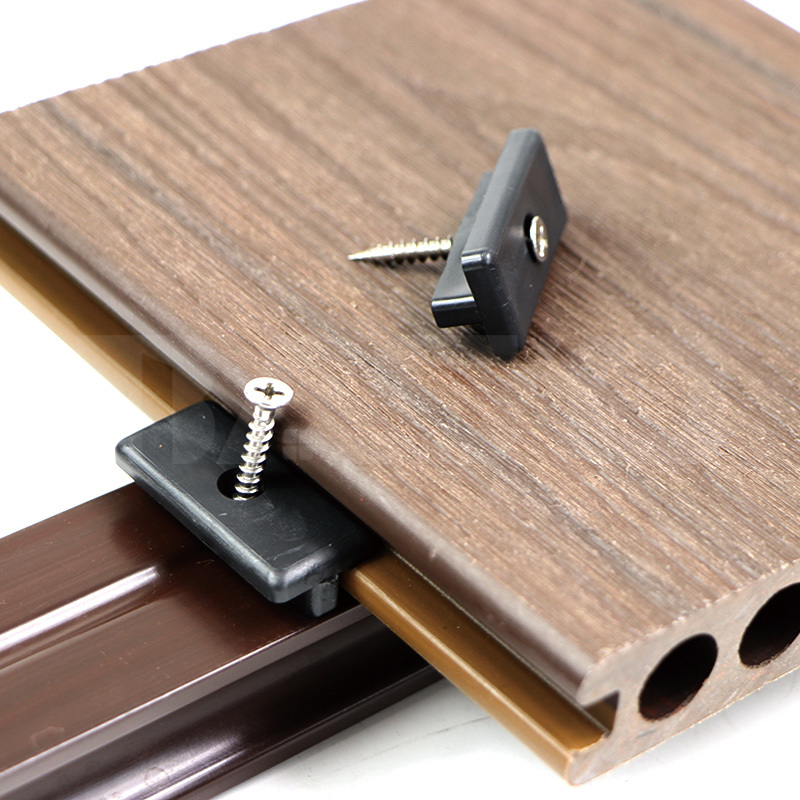 PP Plastic Concealed Decking Clips for Hidden FixingPP plastic concealed clips create a 6 mm ventilation gap and hide fasteners; order with matching boards to ensure groove depth and clip geometry align.View Product →
A few habits keep this line item under control. Order fasteners with the boards so groove depths and clip geometry are guaranteed to match. Choose a concealed clip system over face screws; it installs faster, so you pay less labour, and it leaves a cleaner surface that does not trap dirt. Buy the joist system from the same source as the decking so the spans line up with the board's rated stiffness rather than with guesswork.
Six Ways to Cut the Number Without Cutting Quality
- Choose standard dimensions. A 140mm board is produced in volume, while anything outside the common widths carries a set-up cost.
- Stay with a standard colour and texture. Bespoke colour matching earns its price on a facade, rarely on a floor.
- Order once and order right. Measure the deck, add 8 to 10% for cuts and waste, and resist the urge to buy an extra 20% just in case.
- Buy direct from the manufacturer where you can. Removing a distribution layer usually saves more than any single product upgrade.
- Do the demolition, ground preparation and framing yourself if you are comfortable with it. Preparation labour is easy to take out of a quote; board labour is not.
- Keep the design simple. Straight runs, fewer steps and standard border details all reduce cutting, waste and installation time.
Where Budget Decks Go Wrong
- Buying on price per board alone, then finding the clips, joists and trim are not compatible.
- Ignoring joist spacing. Under-spanned joists void more warranties than any other single mistake.
- Skipping expansion gaps at end joints and walls, so boards push against each other and lift in summer.
- Choosing an uncapped board for a high-UV site and replacing it within three or four seasons.
- Ordering late and paying express freight, which can cost more than the upgrade you were avoiding.
How a Deck Budget Actually Splits
It helps to know where the money goes before you start negotiating, because not every line item responds to pressure in the same way.
| Cost line | Share of a typical project | Where you can save |
|---|---|---|
| Decking boards | 45 to 60% | Profile choice, standard dimensions, order volume |
| Substructure and joists | 10 to 15% | Correct specification, buying with the boards |
| Fasteners, trim and pedestals | 8 to 12% | Hidden clip system, single-supplier compatibility |
| Labour | 20 to 35% | Doing preparation and demolition yourself |
| Freight and delivery | 3 to 8% | Consolidating one shipment, planning ahead |
The lesson in that split is simple: freight and labour are easier to reduce than material quality, and a board that fails early converts a saving into a second purchase.
Buying Direct: Questions Worth Asking Before You Commit
Whether you are buying for one garden or for a stock list, ask for the board's material composition, whether the surface is capped or treated, the warranty terms in writing, the minimum order quantity, and the loading quantity per container. Ask for a sample board and leave it outdoors for a few weeks before you sign anything. You can see how our own boards are produced on the factory page if you would rather see the process before you request pricing.
Budget friendly composite decking is not a secret product line that only insiders know about. It is the same material, specified honestly. Choose the profile that matches how the deck will actually be used, buy the accessories from the same source, and spend your savings where they protect the surface. Do that, and the deck will still be there, looking decent, long after the price difference has been forgotten.
Our News //
Related News
-
Email: [email protected]
Email: [email protected] -
Tel: +86 13732382108
Tel: +86 18705821696 -
 BLDG#1, LONGOUANWU ECO-INDUSTRIALPARK, MIAOXITOWN, WUXINGDISTRICT. HUZHOU. CHINA

Quick Links
Products Center
Copyright © 2025 Huzhou Baosheng New Material Co., Ltd.All Rights Reserved. Composite Decking Manufacturers Composite Cladding Factory
