
 Español
Decking for Outdoors: Complete Material Comparison & Cost Analysis
News-Content
- 1 Why Your Decking Material Choice Matters More Than You Think
- 2 The 4 Main Types of Outdoor Decking: A Side‑by‑Side Comparison
- 3 Composite Decking Deep Dive: Hollow, Solid, Co‑Extrusion & Deep Embossed
- 4 The Hidden Costs of Decking: Installation, Maintenance & Replacement
- 5 Installation Showdown: Hidden Clip System vs Traditional Screws
- 6 What to Look for When Buying Decking for a Commercial Project
- 7 Environmental Impact: Which Decking Material Has the Lowest Carbon Footprint?
Why Your Decking Material Choice Matters More Than You Think
The material underfoot dictates far more than first impressions. It defines how many weekends you spend sanding, staining, or replacing boards over the next 10 to 20 years, and whether your deck adds to your home’s resale value or turns into a liability.
Pressure‑treated pine still sells at roughly $2–$3 per square foot for the boards alone. Composite decking runs $4–$8 per square foot. On a 300‑square‑foot deck, that $600–$1,500 difference in upfront material cost can feel decisive. But those numbers tell only the first chapter of a much longer story.
When the total cost of ownership is calculated over a decade — factoring in sanding, staining, sealing, board replacements, and the scrapped weekends — the math often flips. A 10‑year total cost-of-ownership analysis frequently shows composite decking undercutting wood by 20–30%, thanks to near‑zero annual maintenance and a lifespan that exceeds 25 years even in harsh sun and freeze‑thaw cycles.
This article dissects the four major outdoor decking materials — wood, wood‑plastic composite (WPC), cellular PVC, and aluminum — across initial cost, hidden maintenance, installation speed, structural performance, and environmental footprint. You will also find guidance tailored for contractors and landscape architects who buy by the truckload and need factory‑direct pricing, consistent supply, and documented test data.
The 4 Main Types of Outdoor Decking: A Side‑by‑Side Comparison
Before you compare brands or groove profiles, anchor yourself in the fundamental category differences. Each material occupies a distinct position along the maintenance‑cost‑durability triangle.
| Material | Initial Board Cost (per sq ft) | Annual Maintenance | Typical Lifespan | Environmental Notes | Best Application |
|---|---|---|---|---|---|
| Pressure‑Treated Wood | $2–$3 | High — annual cleaning, staining, sealing | 10–15 years | Renewable resource; chemical treatment; landfilled after use | Budget‑sensitive residential decks in dry climates |
| WPC Composite | $4–$8 | Low — occasional soap‑and‑water wash | 25–30+ years | 30–60% recycled content; limited end‑of‑life recycling | Low‑maintenance residential and light commercial |
| Cellular PVC | $5–$9 | Very low — rinse; no staining needed | 30–40 years | Virgin polymer; higher manufacturing carbon footprint; rarely recycled | Pool surrounds, coastal areas, wet climates |
| Aluminum | $8–$12 | Very low — rinse | 30+ years | High embodied energy but fully recyclable | Fire‑prone zones, commercial rooftops, marine docks |
Wood is the cheapest ticket in but demands the most labor. At the opposite end, aluminum virtually eliminates routine upkeep, but the initial outlay can be hard to justify unless the project faces specific risks like wildfire exposure or salt‑air corrosion.
Composite and PVC sit in the middle ground, with composite often providing the best balance of price, appearance, and thermal stability. Pay attention to the sub‑category of composite, because a hollow board and a co‑extrusion board behave very differently underfoot.
Composite Decking Deep Dive: Hollow, Solid, Co‑Extrusion & Deep Embossed
Not all composite decking is the same. The internal geometry and the surface technology determine how the board handles extreme heat, heavy foot traffic, and staining. Understanding these four variants helps you avoid selecting a product that is undersized for your project’s demands.
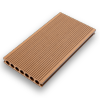
Classic hollow composite boards reduce material cost and weight, making them easy to handle and economical for low‑traffic residential decks. However, the open‑cell structure leaves them more susceptible to expansion‑contraction stress and lower point‑load resistance. Classic solid composite boards — such as those found in a solid composite decking line — avoid hollow‑core weakness while still containing a high percentage of recycled wood fiber and HDPE, offering a more rigid feel and better impact resistance.
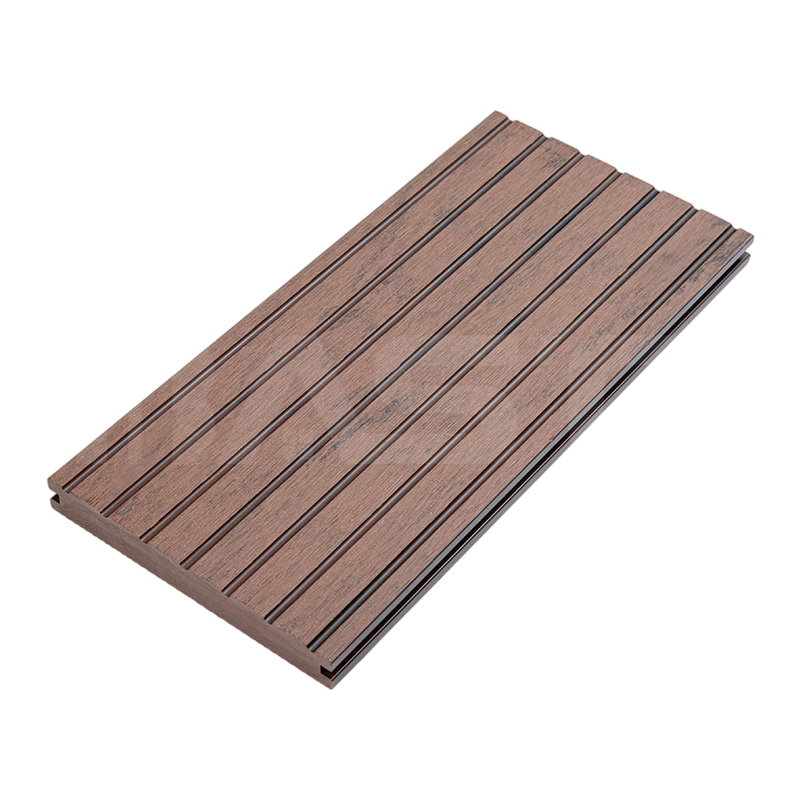
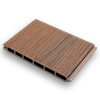
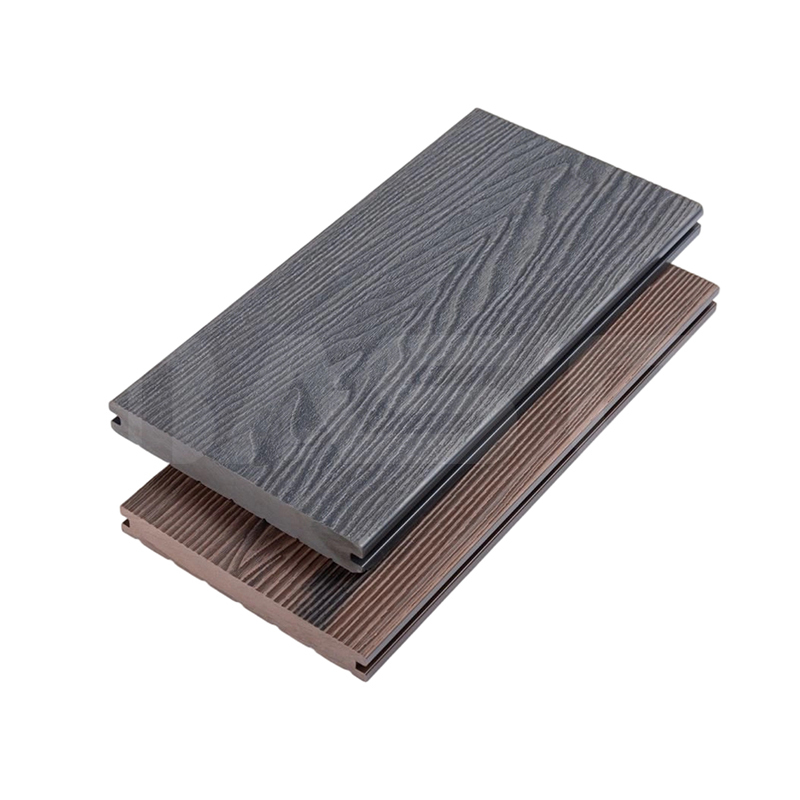
When performance requirements climb further, co‑extrusion decking adds a polymer‑rich cap layer that fully encases the composite core. This cap blocks moisture, resists fading, and provides an extremely tough surface that handles pool chemical splashes and spilled grill grease with minimal care. The protective layer also means co‑extrusion boards show up to 70% less color change over five years than uncapped composite boards, based on accelerated weathering data. You can explore the difference in a co‑extrusion decking series to see how cap color and core formulation work together. Deep‑embossed composites take realism a step further, using 3D texture to mimic wood grain and provide a measurable improvement in slip resistance, often achieving a coefficient of friction above 0.5 in wet conditions.
| Property | Classic Hollow | Classic Solid | Co‑Extrusion | Deep Embossed |
|---|---|---|---|---|
| Bending Strength (psi) | 2,400–2,800 | 3,200–3,600 | 3,500–4,200 | 3,200–3,800 |
| Thermal Expansion (in/in/°F × 10⁻⁶) | 30–38 | 25–30 | 22–28 | 25–32 |
| Wet Slip Resistance (COF) | 0.40–0.45 | 0.42–0.48 | 0.45–0.55 | 0.50–0.60 |
| Best Climate Fit | Mild, covered porches | Moderate sun, inland | Full sun, coastal, pools | Ramps, high‑moisture areas |
If you are building a deck that faces south in a desert climate, a co‑extrusion or deep‑embossed board with a dense cap will minimize buckling and color shift. For a screened‑in porch with no direct rain, a classic solid board offers excellent long‑term value without the premium for the cap layer.
The Hidden Costs of Decking: Installation, Maintenance & Replacement
A deck’s sticker price is deceptive. The lumber that cost $2 per square foot can demand another $6–$7 per square foot in labor to install, followed by annual outlays of $1–$2 per square foot for cleaning, brightening, and sealing. Over 10 years, those invisible costs compound into a sum that dwarfs the initial board price.
The table below projects a 10‑year total cost for a 300‑square‑foot deck using mid‑Atlantic U.S. rates. Labor rates are averaged at $8/sq ft for wood installation and $6/sq ft for composite/PVC, reflecting the speed advantage of hidden fasteners and no sanding steps.
| Cost Component | Pressure‑Treated Wood | WPC Composite | Cellular PVC |
|---|---|---|---|
| Initial board material | $750 | $1,800 | $2,100 |
| Installation labor | $2,400 | $1,800 | $1,800 |
| Year 1–10 maintenance (cleaning, staining) | $3,600 | $300 | $150 |
| Partial board replacement (Year 7) | $400 | $0 | $0 |
| 10‑Year Total | $7,150 | $3,900 | $4,050 |
The numbers tell a clear story. Wood’s upfront advantage vanishes quickly. By year five, cumulative maintenance plus labor already exceeds the composite deck’s total investment. The 10‑year differential reaches roughly $3,200 in favor of composite. If the deck is on a rental property or commercial hospitality setting where downtime for staining means lost revenue, the gap widens further.
Replacement costs are another factor rarely discussed. A wood deck that begins to rot or splinter after 12 years must be fully stripped and rebuilt, incurring disposal fees and new material costs. A composite deck typically lasts twice as long, pushing the second major expense out to a timeframe where many homeowners have already moved on.
Installation Showdown: Hidden Clip System vs Traditional Screws
The way you fasten deck boards down affects the look, the labor bill, and the board’s ability to expand and contract without cracking. For wood, face‑screwing is the norm. For composite and PVC, hidden clip systems have become the professional’s default for a reason.
Traditional top‑down screwing sinks 12–18 fasteners into every 16‑foot board. Every penetration is a potential entry point for moisture and a source of truss‑head rust stains over time. Pre‑drilling is mandatory for many composite products, adding 20–30 minutes per board. Installers often over‑tighten screws to “keep the board flat,” which prevents thermal movement and leads to buckling or cracking at the screw holes within the first full summer.
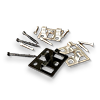
Hidden clips, such as those designed for grooved‑edge boards, mount between planks and fasten to the joist with a single screw or stainless‑steel pin. The clip holds the board securely on its edge while leaving the face untouched. Using a concealed clip system typically cuts installation time by 25–30% and eliminates 100% of surface fasteners — no holes, no rust rings, and no labor for pre‑drilling or plugging. For a closer look at how these clips work with composite profiles, see the range of decking fasteners and concealed clip options compatible with multiple groove designs.
A simplified comparison of the two methods:
- Face screws: Requires pilot holes, visible fastener heads, risk of board splitting, difficult to replace a single board mid‑span, prone to rust staining after 3–5 years in humid climates.
- Hidden clips: No surface penetrations, automatic gapping for expansion, faster install, individual board removal possible, stainless clips resist corrosion for decades.
Specifiers for large‑scale commercial decks routinely choose hidden clip systems because the labor saving alone can offset the slightly higher clip cost. When a crew of four can lay 40% more square feet per day, the math works even before the client sees the cleaner finished surface.
What to Look for When Buying Decking for a Commercial Project
Residential buyers focus on color samples and touch‑and‑feel; commercial buyers need spec sheets. If you are furnishing a rooftop restaurant, a multi‑family walkway, or a municipal boardwalk, the purchase decision hinges on code compliance, safety data, and supply‑chain reliability.
Start with a checklist that covers fire rating, slip resistance, structural load, and color stability. Many countries and U.S. states now require decks in multi‑unit housing to meet a Class‑A or Class‑B flame spread index. Aluminum and PVC can achieve Class‑A without added treatments. Most wood‑plastic composites require specific fire‑retardant formulations to reach Class‑B.
Equally critical is anti‑slip performance. ASTM E303 pendulum test values or DCOF ratings from ANSI A326.3 provide objective criteria. A wet dynamic coefficient of friction of 0.42 or higher is often specified for pool decks and public walkways. Deep‑embossed composite boards and capped PVC with gritty wear layers consistently meet this threshold, whereas smooth, uncapped wood composites may not.
Supply capacity also separates manufacturers who can serve a 15,000‑square‑foot order in six weeks from those who cannot. Ask for documented monthly output per line and typical lead times for a 40‑foot container. Bulk buyers frequently reduce material costs by 20–35% when dealing directly with factory‑owned operations that control extrusion, blending, and tooling under one roof. The ability to produce custom lengths, matching fascia trims, and coordinated decking, railing, and cladding profiles in a single order simplifies project logistics.
A quick commercial vetting checklist:
- Flame spread rating (ASTM E84): Class A or B required for high‑rise and multi‑family
- Slip resistance (ASTM E303 or DCOF): Minimum 0.42 wet
- Color consistency (ΔE after 3,000‑hour QUV): Under 5 for high‑end projects
- Warranty coverage: Minimum 25‑year structural, transferable
- Factory capacity: Proven ability to deliver 10,000+ sq ft in a single phase
Environmental Impact: Which Decking Material Has the Lowest Carbon Footprint?
Sustainability claims in decking are easy to make and hard to verify without life‑cycle data. The full picture includes raw material extraction, manufacturing energy, transportation weight, longevity, and end‑of‑life fate.
Wood stores carbon during its growth phase, but pressure‑treating chemicals and shorter service life pull its overall score down. Composite boards that incorporate recycled HDPE and recovered wood fiber reduce landfill burden and avoid the need for wood preservatives. Independent life‑cycle assessments indicate that composite decking with 60% recycled content can generate roughly 50% less greenhouse gas per square foot than virgin cellular PVC, primarily because the polymer fraction comes from post‑consumer packaging that already carried an upstream footprint.
| Material | Carbon Footprint (kg CO₂ eq/sq ft) | Recycled Content (typical) | End‑of‑Life Pathway |
|---|---|---|---|
| Pressure‑Treated Pine | 3.5–4.5 | 0% | Landfill or incineration (chemical leaching risk) |
| WPC Composite (30‑60% recycled) | 5.0–8.0 | 30‑60% | Mostly landfill; limited mechanical recycling trials |
| Cellular PVC | 10.0–14.0 | 0‑10% | Landfill; not recyclable in most municipal streams |
| Aluminum | 18.0–22.0 | 30‑50% (post‑industrial common) | Fully recyclable at end of life |
Aluminum carries the highest initial carbon burden but is infinitely recyclable, which shifts the equation in projects where the deck at end‑of‑life will be deconstructed and returned to a scrap stream. Wood, despite being bio‑based, often ends up in landfills where anaerobic decomposition releases methane. WPC composite splits the difference — modest upfront carbon, moderate recyclability, and the longest expected service life of any non‑metal option, which delays the replacement‑cycle emissions.
If minimizing the total carbon footprint is your primary goal, look for composite boards that explicitly state a minimum 60% post‑consumer recycled content and that are manufactured in facilities using renewable energy for extrusion. Request an environmental product declaration (EPD) from the supplier to verify the numbers instead of relying on marketing language.
Whichever material you choose, proper design extends its useful life. Ensuring a 2% slope for drainage, adequate ventilation underneath, and correct joist spacing keeps biological decay and warping at bay, which in turn keeps the material out of the waste stream longer. The most sustainable deck is the one you build once and never have to rebuild.
Our News //
Related News
-
Email: [email protected]
Email: [email protected] -
Tel: +86 13732382108
Tel: +86 18705821696 -
 BLDG#1, LONGOUANWU ECO-INDUSTRIALPARK, MIAOXITOWN, WUXINGDISTRICT. HUZHOU. CHINA

Quick Links
Products Center
Copyright © 2025 Huzhou Baosheng New Material Co., Ltd.All Rights Reserved. Composite Decking Manufacturers Composite Cladding Factory
