



 Español
How Hotels and Resorts Are Using Composite Decking to Cut Maintenance Costs
News-Content
- 1 Why Traditional Wood No Longer Makes Business Sense for Hotels
- 2 The Maintenance Math Behind the Switch to Composite
- 3 What Hotel Projects Demand From Composite Materials
- 4 Co-Extrusion Technology: The Premium Tier for High-Traffic Venues
- 5 Sustainability as a Hotel Brand Asset, Not Just a Material Benefit
- 6 Installation Considerations for Hotel Projects
- 7 What to Look for When Sourcing Composite Decking for a Hotel or Resort
- 8 The Direction the Industry Is Moving
Across the hospitality industry, property managers and hotel developers are rethinking one of their most stubborn recurring expenses: outdoor surface maintenance. From poolside terraces and rooftop bars to beachfront walkways and spa lounges, the surfaces guests walk on require constant upkeep — and traditional wood decking has long been one of the biggest culprits of ballooning maintenance budgets. Composite decking is rapidly becoming the preferred solution, offering hotel operators a way to dramatically cut long-term costs without sacrificing the visual appeal guests expect.
What started as a niche residential product has matured into a commercial-grade material now specified in hospitality projects worldwide. The shift is driven by a simple calculation: the lower the ongoing maintenance burden, the more resources a property can redirect toward guest experience.
Why Traditional Wood No Longer Makes Business Sense for Hotels
Hardwood and pressure-treated timber have been the default choice for hotel decking for decades, but their real costs only become visible over time. A typical commercial wood deck requires sanding, staining, sealing, or painting at least once every one to two years. In high-traffic hotel environments — where surfaces endure foot traffic, poolside moisture, UV exposure, and frequent cleaning — that maintenance cycle compresses further.
Beyond the material costs, there's a hidden toll that hotels rarely account for upfront: service disruption. Sanding and resealing a pool deck or terrace means temporarily closing that amenity, which directly affects guest satisfaction scores and, in peak season, can cost far more than the maintenance itself.
Wood is also vulnerable in ways that composite materials are simply not. Rot, insect infestation, warping from humidity shifts, and UV fading are chronic issues that require reactive repairs rather than scheduled, predictable maintenance. For hotel operations teams managing dozens of priorities simultaneously, unpredictable infrastructure failures are a serious liability.
The Maintenance Math Behind the Switch to Composite
The financial case for composite decking in hotels centers on one core truth: composite decking requires no sanding, painting, staining, or sealing. Routine care is limited to periodic cleaning with soap and water. That alone eliminates an entire category of annual operating expenses that hotels have historically absorbed as unavoidable.
Industry estimates suggest that over a 10-year period, composite decking can reduce total maintenance costs by 50 to 70 percent compared to timber alternatives. For a mid-sized resort with several thousand square feet of outdoor decking, this translates into tens of thousands of dollars in savings — funds that can be redirected toward guest amenities, renovation, or staffing.
| Maintenance Factor | Traditional Wood Decking | Composite Decking |
|---|---|---|
| Annual sanding/staining | Required | Not required |
| Rot / insect damage risk | High | Negligible |
| UV / fade resistance | Requires treatment | Built-in |
| Warping / cracking | Common in wet areas | Engineered to resist |
| Service disruption during maintenance | Frequent | Minimal |
What Hotel Projects Demand From Composite Materials
Hospitality applications place unique demands on decking materials that go well beyond what a residential product typically needs to deliver. Hotel general managers and procurement teams now evaluate composite decking across several specific criteria:
- Slip resistance: Pool decks and spa areas demand surfaces that remain safe when wet, making the texture and surface profile of composite boards a critical specification point.
- UV and fade resistance: Outdoor surfaces in coastal or sun-intensive destinations face extreme UV exposure. Materials that maintain their color without recoating are essential for keeping branded aesthetic standards consistent year over year.
- Anti-corrosion and anti-pest performance: In tropical and coastal environments, composites must resist salt air, humidity-driven corrosion, and insect pressure without requiring chemical treatments.
- Design flexibility: Hotels are not one-size-fits-all. Procurement teams increasingly seek suppliers who can accommodate custom dimensions, color palettes, and surface textures that align with a property's design language.
These requirements have pushed composite decking manufacturers to develop more sophisticated product lines specifically suited to commercial and hospitality-scale projects.
Co-Extrusion Technology: The Premium Tier for High-Traffic Venues
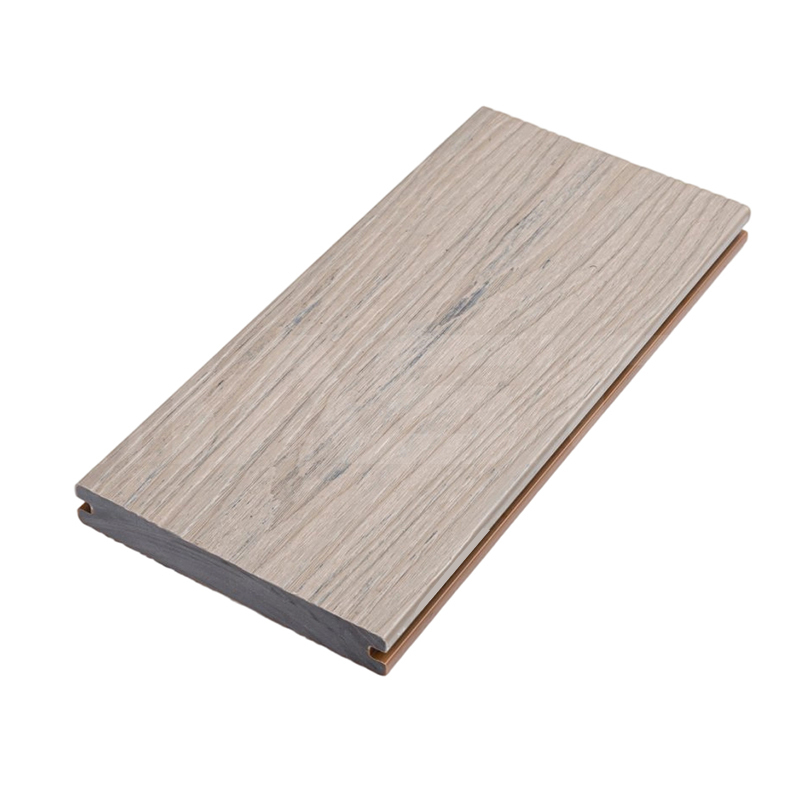
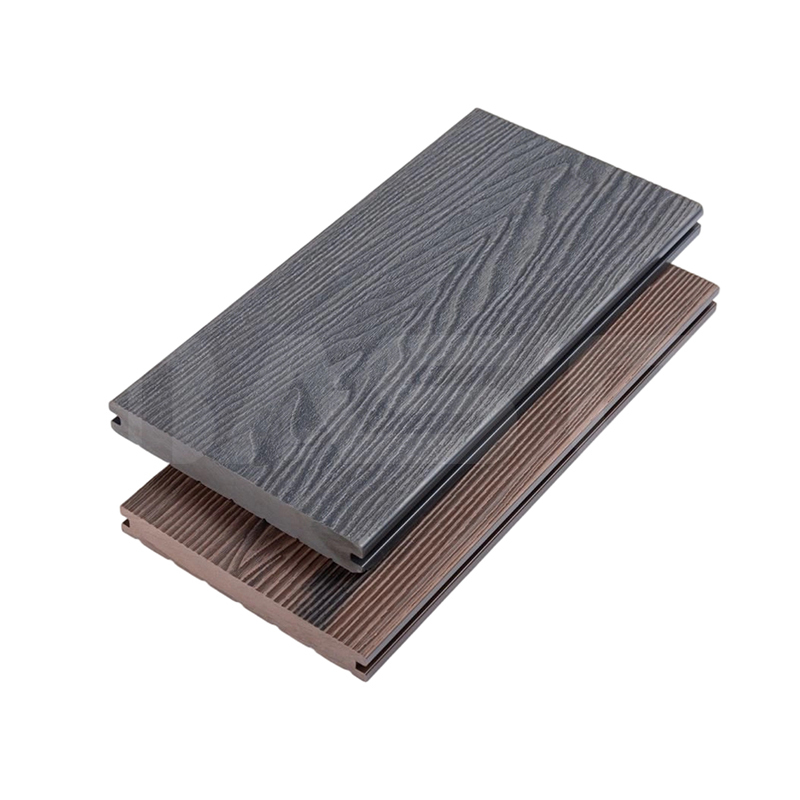
Among the composite decking options now available, co-extrusion technology represents the highest performance tier — and it's the specification most commonly selected for luxury hotel and resort projects. In co-extrusion manufacturing, a protective polymer shell is fused directly around the composite core during production, rather than applied as a surface coating afterward. The result is a board with superior resistance to staining, scratching, moisture penetration, and UV fading.
For hotel operators, co-extrusion decking's most commercially significant attribute is its stain resistance. Pool areas, outdoor dining terraces, and rooftop bars are environments where food, beverages, sunscreen, and cleaning chemicals regularly contact the surface. A co-extruded board's protective shell repels these substances at a level that neither standard WPC composite nor treated timber can match.
Suppliers such as BASO Composite have developed co-extrusion decking lines specifically addressing the performance requirements of commercial outdoor installations, with boards engineered for long service life in demanding environments. The company, based in Huzhou City, Zhejiang Province, operates more than 20 production lines and has accumulated over eight years of export experience supplying markets across more than 25 countries — including hospitality projects in Europe, Southeast Asia, and the Middle East.
Sustainability as a Hotel Brand Asset, Not Just a Material Benefit
Beyond maintenance economics, the sustainability profile of composite decking has become a meaningful consideration for hotel brands competing on environmental credentials. Guests — particularly in the premium and luxury segments — increasingly evaluate properties through a sustainability lens, and the materials visible in outdoor spaces are part of that perception.
High-quality composite decking is manufactured using significant proportions of recycled content. BASO Composite, for example, produces boards using approximately 60% natural wood fiber alongside 30% recycled HDPE plastic — a formulation that gives the material its dimensional stability while reducing reliance on virgin raw materials. The company reports that each ton of product manufactured reduces plastic pollution equivalent to 60,000 plastic bags and conserves approximately 80 barrels of oil compared to conventional material production.
For hotel brands pursuing green building certifications or sustainability reporting commitments, specifying composite decking with documented recycled content contributes measurably to those targets. It's an operational choice that simultaneously reduces cost and strengthens brand positioning — a combination that's rare in commercial construction decisions.
Installation Considerations for Hotel Projects
Hotel procurement teams evaluating composite decking should account for a few installation factors that differ from residential applications at commercial scale:
- Hidden fastener systems are strongly preferred for hotel applications. Clips installed between boards leave a clean, seamless surface with no exposed hardware — the standard expected in upscale hospitality design. Most commercial composite decking suppliers now offer proprietary hidden clip systems as a standard accessory alongside their boards.
- Adjustable pedestal systems allow composite decking to be installed over irregular or sloped substrates — particularly relevant for rooftop installations where waterproof membrane protection is a priority. Pedestals maintain the membrane integrity while creating a level, drainable surface above.
- Thermal expansion allowances must be factored into commercial installations, particularly in locations with significant temperature variation between seasons. Composite boards expand and contract with temperature; proper spacing specified by the manufacturer prevents buckling and maintains the installation's appearance over time.
Working with suppliers experienced in commercial-scale projects makes a meaningful difference at this stage. Manufacturers with dedicated technical support teams — and the capacity to supply consistent product quality across large orders — reduce project risk considerably compared to residential-focused distributors adapting their offering to hotel-scale requirements.
What to Look for When Sourcing Composite Decking for a Hotel or Resort
For hospitality procurement managers beginning supplier evaluation, the following criteria consistently differentiate manufacturers capable of meeting commercial-grade requirements:
- Product range depth: A supplier with hollow, solid, deep embossed, and co-extrusion product lines gives specifiers the flexibility to match the right product tier to each application within a property — a pool deck may warrant co-extrusion performance, while a lower-traffic garden path may be appropriately served by a classic hollow board.
- Customization capability: Hotel projects often require non-standard dimensions, colors, or surface textures. Manufacturers with in-house R&D teams and flexible production tooling — rather than fixed catalog-only offerings — are better positioned to meet project-specific design requirements.
- Quality certification: ISO and CE certifications signal that quality management systems are in place and independently verified — an important baseline for commercial procurement due diligence.
- Supply chain reliability: Large hospitality projects require consistent material supply across extended timelines. Suppliers with significant production capacity and documented export experience across multiple markets are lower-risk partners for large-scale installations.
- Warranty terms: Commercial-grade composite decking should carry a meaningful product warranty. Reviewing warranty scope — particularly coverage for fading, staining, and structural integrity — provides an objective measure of manufacturer confidence in long-term performance.
The Direction the Industry Is Moving
The transition from timber to composite decking in the hospitality sector is no longer a niche trend — it reflects a structural shift in how hotel developers and operators think about long-term asset management. As sustainability reporting requirements tighten and labor costs for skilled maintenance trades continue to rise in most markets, the economics of composite decking improve further with each passing year.
Newer product developments — particularly in co-extrusion decking technology — continue to close any remaining performance gaps that once gave specifiers reason to consider premium timber alternatives. The result is a material category that now genuinely competes on aesthetics, performance, and total cost of ownership simultaneously, rather than asking buyers to compromise on any of those dimensions.
For hotels and resorts making investment decisions on outdoor surfaces in the coming cycle, composite decking merits evaluation not as an alternative to wood, but as the baseline specification — with timber treated as the option that requires justification rather than the obvious default.
Our News //
Related News
-
Email: [email protected]
Email: [email protected] -
Tel: +86 13732382108
Tel: +86 18705821696 -
 BLDG#1, LONGOUANWU ECO-INDUSTRIALPARK, MIAOXITOWN, WUXINGDISTRICT. HUZHOU. CHINA

Quick Links
Products Center
Copyright © 2025 Huzhou Baosheng New Material Co., Ltd.All Rights Reserved. Composite Decking Manufacturers Composite Cladding Factory
