
 Español
WPC Fence vs. Aluminium Fence: Which One Lasts Longer Outdoors?
News-Content
- 1 What Makes a Fence "Last" Outdoors?
- 2 How Long Does WPC Fencing Actually Last?
- 3 How Long Does Aluminium Fencing Last?
- 4 Head-to-Head: Durability in Different Climates
- 5 Total Cost of Ownership: Which Saves More Over Time?
- 6 Maintenance Requirements That Affect Lifespan
- 7 Which One Lasts Longer? Our Verdict
Outdoor fences face a relentless mix of UV radiation, moisture, frost, salt air, and physical impact — year after year. Choosing the wrong material doesn't just mean a worn-out fence; it means unexpected repair bills, early replacement, and wasted investment. WPC (Wood Plastic Composite) and aluminium are two of the most widely specified fencing materials today, and both claim impressive longevity. But the real question isn't just how long each material can last in ideal conditions — it's how each one holds up in your outdoor environment over the long term.
What Makes a Fence "Last" Outdoors?
Longevity in a fence isn't a single number — it's the result of how well a material resists a combination of stresses over time. The key durability factors that determine outdoor lifespan include:
- UV radiation: Prolonged sun exposure degrades surface polymers, causing fading, chalking, and structural weakening
- Moisture and humidity: Water ingress drives rot in organic materials and accelerates coating failure in metals
- Thermal cycling: Repeated expansion and contraction from temperature swings causes warping, cracking, or joint fatigue
- Corrosion and oxidation: Salt-laden coastal air and soil contact accelerate surface corrosion, especially at cut edges and fastener points
- Physical impact: Wind load, accidental strikes, and structural stress over time can compromise rigidity
A fence that performs well across all five categories — not just one or two — is the one that will still look and function correctly after two or three decades outdoors.
How Long Does WPC Fencing Actually Last?
Quality WPC fencing typically carries manufacturer warranties of 15–25 years for outdoor use, and in well-maintained conditions it can comfortably reach that upper range. The material achieves this by combining recycled wood fibres with a thermoplastic polymer matrix — a structure that eliminates the two most common causes of timber fence failure: rot and insect damage. Unlike untreated wood, which often needs replacement within 5–10 years, WPC holds its structural integrity without painting, staining, or sealing.
The primary long-term risk for WPC is UV-driven polymer degradation. Research published in peer-reviewed materials science literature confirms that prolonged UV exposure causes surface chain scission in the polymer matrix — leading to gradual colour fading, increased surface roughness, and reduced impact resistance over time. Modern WPC products address this through co-extrusion technology, which applies a dense, UV-stabilised outer shell over the composite core. This protective cap layer significantly slows surface degradation compared to first-generation uncapped WPC profiles. You can see how this technology is applied across co-extrusion composite profiles in outdoor building materials.
It's also worth noting that WPC performance can vary significantly by formulation. Products tested under industry standards for wood-plastic composite mechanical and physical properties demonstrate the wide range in stiffness, moisture uptake, and UV resistance depending on resin quality and wood fibre content. Always look for co-extruded products with documented UV stabiliser content if maximum longevity is the priority.
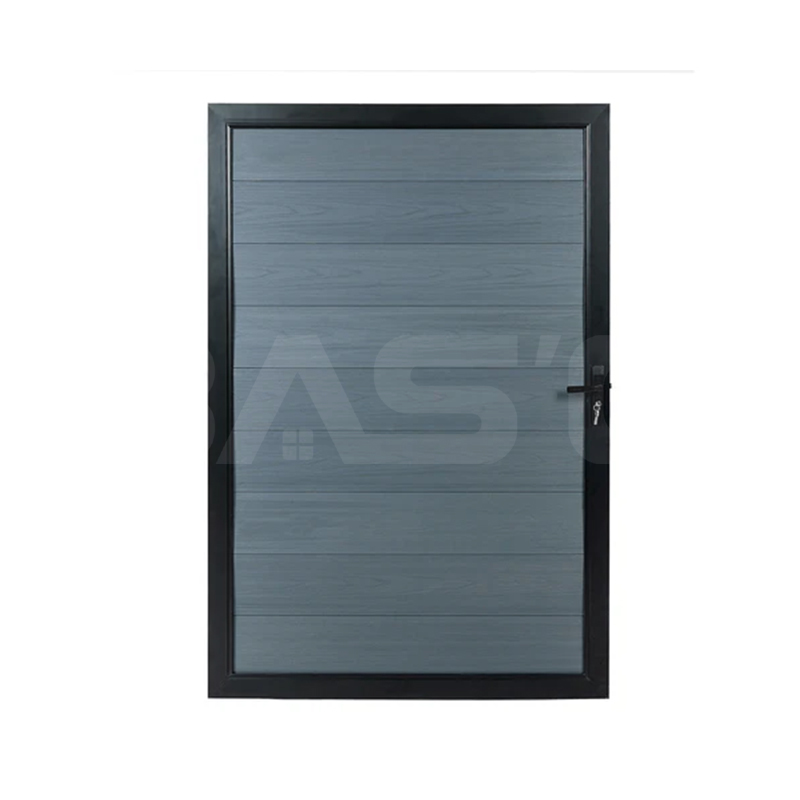
Explore WPC fence panels built for outdoor durability to see specification details and available profiles.
How Long Does Aluminium Fencing Last?
Powder-coated aluminium fencing is one of the longest-lasting fencing materials available, with a realistic service life of 30+ years under normal outdoor conditions. Aluminium doesn't rust — not in coastal air, not buried partially in soil, not after decades of wet winters. This is a fundamental material property: aluminium naturally forms a stable oxide layer that prevents further corrosion, and powder coating adds a second barrier that reinforces this protection.
The primary failure mode for aluminium fencing isn't the metal itself — it's the coating system. At weld points, cut edges, and fastener holes, the powder coating can chip or crack over time. Once the base metal is exposed at these points, galvanic corrosion can begin, particularly in coastal or high-humidity environments. This is why aluminium fences in saltwater climates benefit from periodic inspection of joints and fasteners, even if the panels themselves require little attention.
Structurally, aluminium is notably rigid with minimal creep under long-term load — a meaningful advantage for tall fence runs or high-wind installations. It doesn't warp, expand significantly, or lose dimensional stability the way wood-based composites can in extreme heat. Browse aluminium fence options for modern outdoor spaces to compare available styles and finishes.
Head-to-Head: Durability in Different Climates
Climate is the single most important variable in real-world fence lifespan. The same product can perform very differently in a desert suburb versus a coastal marina. Here's how each material fares across four common outdoor environments:
| Climate Type | WPC Fencing | Aluminium Fencing |
|---|---|---|
| Coastal / High Salt Air | Excellent — unaffected by salt, no corrosion risk | Good — inherently corrosion-resistant, but weld points need monitoring |
| Tropical / High Humidity | Excellent — no rot, no mould penetration with capped profiles | Excellent — moisture has no structural effect |
| Cold / Freeze-Thaw Cycles | Good — quality WPC handles freeze-thaw well; avoid uncapped profiles | Excellent — aluminium is unaffected by cold and does not become brittle |
| Dry / High UV Exposure | Good — co-extruded WPC resists UV well; standard WPC may fade faster | Excellent — no UV degradation; powder coat may slowly chalk over decades |
The key takeaway: aluminium holds a slight edge in cold and high-UV environments due to its structural stability, while co-extruded WPC matches it closely in coastal and tropical conditions — and offers a meaningfully warmer aesthetic in those settings. In regions with severe UV exposure, independent research on how UV irradiation affects the long-term properties of wood-plastic composites suggests that polymer stabiliser quality is the decisive factor — making product specification more important than the material category alone.
Total Cost of Ownership: Which Saves More Over Time?
Purchase price tells only part of the story. A lower upfront cost can be quickly erased by maintenance expenses, coating renewals, or premature replacement. Looking at a 25-year ownership window, the cost picture shifts considerably.
| Cost Category | WPC Fencing | Aluminium Fencing |
|---|---|---|
| Initial Material Cost | Mid-range | Higher upfront |
| Installation | Moderate (heavier panels) | Lower (lightweight, fast to install) |
| Annual Maintenance | Minimal — soap and water cleaning | Minimal — occasional joint inspection |
| Repainting / Recoating | None required | Occasional touch-up at weld points |
| Expected Replacement | 20–25 years | 30+ years |
| 25-Year TCO | Competitive | Slightly higher upfront, lower long-term |
For buyers with a longer investment horizon — commercial properties, permanent residential installations — aluminium's extended service life and near-zero structural maintenance often results in a lower total cost per year of service. For residential buyers prioritising a natural wood aesthetic and a lower initial outlay, quality WPC delivers strong value over a 20+ year lifespan without any of the ongoing costs associated with traditional timber.
Maintenance Requirements That Affect Lifespan
How a fence is maintained has a direct impact on how long it lasts — regardless of material. Both WPC and aluminium are classified as low-maintenance fencing options, but "low maintenance" is not the same as "no maintenance."
WPC fencing needs only periodic cleaning with soapy water to prevent algae or dirt build-up on the surface. The co-extruded shell resists staining, and no painting, sealing, or sanding is ever required. In shaded or damp environments, a biocidal wash once or twice a year will keep the surface looking fresh. Fasteners and post bases should be checked annually to ensure no water is pooling.
Aluminium fencing requires even less routine attention — a rinse down a couple of times a year is typically sufficient. The main inspection task is checking welds, cut ends, and screw holes for coating damage. If bare metal is exposed at any point, a touch-up with compatible powder coat spray prevents the localised corrosion that can otherwise shorten the fence's service life disproportionately.
The bottom line on maintenance: neither material demands significant time or cost over its lifetime. WPC's edge is in coastal environments where aluminium's weld points need more regular inspection. Aluminium's edge is in desert or cold-weather climates where thermal expansion in WPC requires occasional fastener checks.
Which One Lasts Longer? Our Verdict
On pure lifespan, aluminium has the edge — a well-specified powder-coated aluminium fence can realistically outlast a WPC fence by five to ten years, making it the better choice for long-horizon commercial projects or installations where replacement is highly disruptive.
But the gap narrows considerably with co-extruded WPC. A quality capped WPC fence in a typical residential setting will deliver 20–25 years of reliable performance with virtually no maintenance cost — and it does so with a warmth and texture that aluminium simply cannot replicate. For gardens, residential boundaries, and any project where aesthetics and privacy matter as much as longevity, WPC is the more practical choice for most buyers.
The best decision framework is straightforward:
- Choose aluminium if longevity beyond 25 years is paramount, you prefer a modern open design, or you're specifying a commercial or high-security installation
- Choose WPC if natural aesthetics matter, the project requires solid privacy panels, or you need a cost-effective long-term solution without the premium aluminium upfront cost
- In coastal environments, both materials perform well — but WPC's complete corrosion immunity with no coating gives it a practical advantage
Both materials are a significant step above timber and represent the benchmark for low-maintenance outdoor fencing today. Explore the full range of outdoor fencing solutions — including WPC, aluminium, and PVC fencing as a third alternative — to compare specifications and find the right fit for your project.
Our News //
Related News
-
Email: [email protected]
Email: [email protected] -
Tel: +86 13732382108
Tel: +86 18705821696 -
 BLDG#1, LONGOUANWU ECO-INDUSTRIALPARK, MIAOXITOWN, WUXINGDISTRICT. HUZHOU. CHINA

Quick Links
Products Center
Copyright © 2025 Huzhou Baosheng New Material Co., Ltd.All Rights Reserved. Composite Decking Manufacturers Composite Cladding Factory
