
 Español
Co-Extrusion vs Classic WPC Wall Panels for Facades: How to Choose
News-Content
- 1 What Makes Co-Extrusion Different from Classic WPC
- 2 Surface Durability: The Biggest Gap Between the Two
- 3 Color Retention and Aesthetic Consistency Over Time
- 4 Maintenance Requirements and Expected Lifespan
- 5 Cost Comparison: Upfront Price vs Long-Term Value
- 6 Which Panel Is Right for Your Facade Project?
Facade material selection comes down to one question builders face before every exterior project: how long will this look good, and what will it cost to keep it that way? Both co-extrusion and classic WPC wall panels are composite materials built from wood fiber and plastic — but the gap in performance between them is wider than most buyers expect. Understanding where that gap comes from, and whether it matters for your specific project, is what this guide is designed to help you work out.
What Makes Co-Extrusion Different from Classic WPC
Classic WPC is produced through a single-step extrusion process. Wood fiber and plastic — typically HDPE or PVC — are blended together with additives and pushed through a die to form a board. The result is a homogenous material: the same composition all the way through, from surface to core. These are classic WPC wall panels for facades that have been the standard in composite cladding for over a decade — reliable, affordable, and well-understood.
Co-extrusion is a fundamentally different manufacturing process. The core of the board is formed first — essentially the same WPC blend — but as it exits the die, a separate polymer shell is simultaneously extruded and permanently fused around the outside. This shell, typically made from ASA or PVC, is engineered specifically for surface protection, not structural performance. The result is a board with two distinct layers serving two distinct jobs.
These co-extrusion wall panels with a protective polymer shell represent the second generation of WPC technology. The shell is what drives every performance advantage — and it is also what drives the price premium. Understanding what that shell actually does in real-world facade conditions is the key to deciding whether you need it.
Surface Durability: The Biggest Gap Between the Two
On a facade, the surface takes everything the environment delivers: UV radiation, rain, thermal expansion and contraction, airborne pollutants, and in some locations, salt spray. Classic WPC handles moderate exposure well, but its homogenous structure means the surface layer is the same material as the core — and it was not designed with surface resilience as its primary function.
Over time, classic WPC surfaces are susceptible to micro-scratching, surface staining that penetrates the material, and progressive UV degradation that can cause uneven color changes. In sheltered residential locations with mild climates, these effects may take years to become visible. In high-UV environments, coastal zones, or commercial locations with heavy footfall or pollution exposure, they become apparent much sooner.
The co-extrusion shell changes this completely. ASA-based shells are engineered to resist UV degradation at a molecular level, maintain stain resistance as a surface property rather than a material property, and absorb mechanical wear without exposing the core. The shell takes the damage so the core does not have to. In coastal areas with salt-laden air and frequent rain, co-extruded panels maintain surface integrity where classic panels would show warping or discoloration within a few seasons.
For facades specifically — where the surface is permanently exposed and not protected by foot traffic patterns or shade structures — this surface protection advantage translates directly into how the building looks five, ten, and twenty years from installation.
Color Retention and Aesthetic Consistency Over Time
Facade aesthetics are a long-term commitment. Once a building is clad, the expectation is that it will look intentional and maintained for decades — not just at handover. This is where color retention becomes a specification priority rather than a marketing point.
Classic WPC panels are prone to uneven fading as UV exposure breaks down the pigments distributed throughout the homogenous material. The fading tends to be non-uniform: panels in direct sun fade faster than those in shadow, south-facing elevations bleach differently from north-facing ones, and edges and corners — where the material is thinner — show color change before the panel faces. The result over time is a patchwork effect that reads as premature aging.
Co-extruded panels behave differently because the color is concentrated in the shell, and that shell is formulated with UV stabilizers as a primary engineering objective. Color change is minimal and — critically — it is uniform across the installation. Even if there is some gradual shift over years of sun exposure, the facade maintains visual coherence because all panels change at the same rate. For architects and developers specifying premium residential or commercial facades, this consistency is non-negotiable.
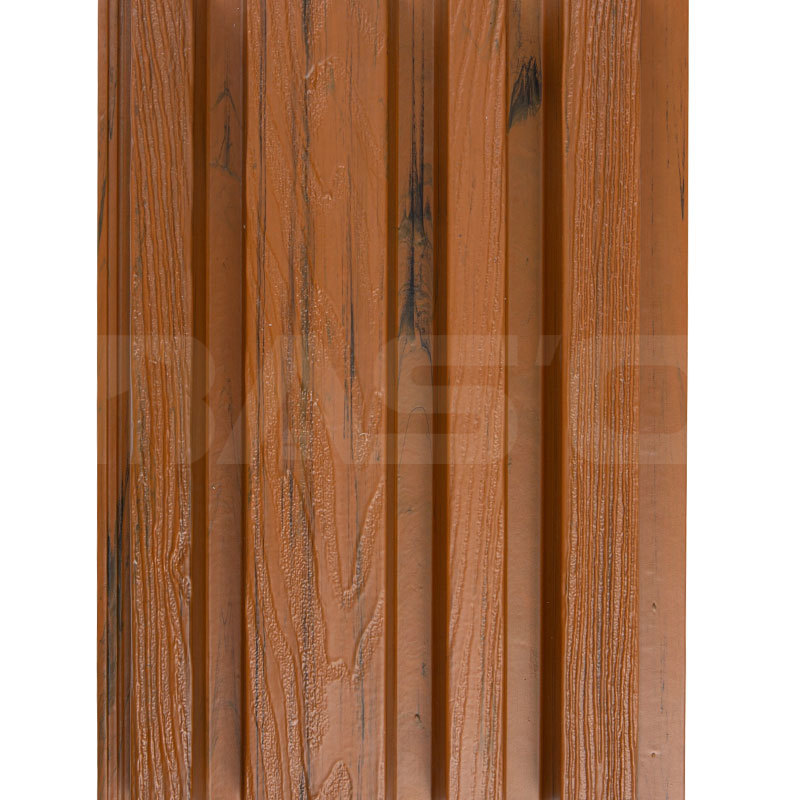
Co-extruded technology also enables a wider palette of colors and more detailed surface textures — deeper wood grain embossing, richer tonal variation, and finishes that more closely replicate natural timber — because the shell can be formulated independently of the core's structural requirements.
Maintenance Requirements and Expected Lifespan
Both WPC types market themselves as low-maintenance compared to natural timber, and both are — relative to wood that requires periodic oiling, staining, and treatment. But the maintenance gap between classic and co-extruded WPC is significant, and it compounds over a building's service life.
Classic WPC facades in stain-prone environments — poolside, restaurant terraces, urban locations with airborne grime — typically require periodic cleaning treatments to maintain appearance. Surface scratches may need attention to prevent moisture ingress into the exposed material. In humid or shaded conditions, mold can colonize the surface layer. The panels remain structurally sound, but keeping them looking presentable requires active maintenance cycles. Refer to the manufacturer's warranty and care guidelines for the recommended intervals specific to your product.
Co-extruded panels are genuinely close to maintenance-free. The polymer shell resists staining at the surface, so most contamination cleans off with water. Mold has no foothold in the non-porous shell surface. Scratch resistance means normal wear does not create pathways for moisture. Expected lifespans of 25+ years with minimal upkeep are a realistic specification for well-installed co-extruded cladding in most climates. For classic WPC, realistic lifespan under outdoor facade conditions — accounting for maintenance requirements and surface degradation — typically ranges from 15 to 20 years in moderate climates, less in harsh ones.
Cost Comparison: Upfront Price vs Long-Term Value
Co-extrusion panels carry a higher unit price than classic WPC — typically in the range of 15–30% more at point of purchase, depending on profile, supplier, and order volume. For large facade installations, this premium is a material budget line that project managers notice. But framing the decision purely on upfront material cost misses where the real financial difference lies.
The lifecycle cost calculation favors co-extrusion more strongly the longer the planning horizon and the harsher the exposure conditions. Classic WPC maintenance cycles — professional cleaning, surface treatments, potential early partial replacement of panels showing severe degradation — add costs that accumulate invisibly against the original savings. For a commercial building where facade maintenance requires scaffolding, the cost of each maintenance intervention is high. For a residential developer with a building warranty obligation, panels that age prematurely create liability.
| Factor | Classic WPC | Co-Extrusion WPC |
|---|---|---|
| Upfront material cost | Lower | 15–30% higher |
| Maintenance frequency | Periodic treatment required | Minimal — wash only |
| Color consistency over time | Uneven fading likely | High uniformity |
| Expected service life | 15–20 years (moderate climate) | 25+ years |
| Best for | Budget-conscious, sheltered installs | High-exposure, long-term projects |
For a detailed cost-per-year breakdown applied to composite materials more broadly, the detailed cost comparison for composite decking illustrates how lifecycle modelling shifts the calculus away from upfront price and toward total cost of ownership — the same principle applies directly to wall panel specification.
Which Panel Is Right for Your Facade Project?
The choice is not always co-extrusion. There are genuine cases where classic WPC is the right specification — and forcing co-extrusion into every project is not good material economics. The decision should follow the exposure conditions, project lifespan, and budget structure of each specific installation.
Choose classic WPC wall panels when: the facade is sheltered or faces away from prevailing weather; the building has a short design life or is in a category where periodic renovation is expected; the project budget is tightly constrained and the installation environment is mild; or the visual requirement is a matte, high-wood-fiber texture that classic WPC's 70% natural fiber content delivers particularly well.
Choose co-extrusion wall panels when: the facade faces full sun or coastal conditions; the project has a 20+ year performance expectation; the client requires guaranteed color uniformity across the full elevation; or the installation is in a high-traffic or commercial context where maintenance costs are operationally significant. Luxury residential, hospitality, and commercial developments overwhelmingly fall into this category.
Climate zone is the single most reliable decision filter. In regions with intense UV exposure, high humidity, or salt air, the performance gap between classic and co-extrusion becomes decisive within just a few years. In temperate, sheltered conditions, classic WPC remains a competitive and cost-effective choice.
Explore the full wall cladding product range to compare available profiles, dimensions, and colors across both technologies — and request samples to evaluate surface finish and texture before committing to a specification.
Our News //
Related News
-
Email: [email protected]
Email: [email protected] -
Tel: +86 13732382108
Tel: +86 18705821696 -
 BLDG#1, LONGOUANWU ECO-INDUSTRIALPARK, MIAOXITOWN, WUXINGDISTRICT. HUZHOU. CHINA

Quick Links
Products Center
Copyright © 2025 Huzhou Baosheng New Material Co., Ltd.All Rights Reserved. Composite Decking Manufacturers Composite Cladding Factory
