
 Español
Red Composite Deck Boards: Top Brands, Cost & Installation Guide
News-Content
- 1 Why Choose Red Composite Decking?
- 2 Top Red Composite Deck Board Brands Compared
- 3 Color and Texture: What to Look for in Red Deck Boards
- 4 Cost Analysis: Red Composite Decking vs Other Colors
- 5 Installation Tips for Red Composite Deck Boards
- 6 Long-Term Performance: Fade Resistance and Maintenance
- 7 Where to Buy Red Composite Deck Boards
Why Choose Red Composite Decking?
Red composite deck boards do more than add color — they redefine the entire visual rhythm of an outdoor space. While grey and brown dominate most backyard decks, red creates an anchor point that draws the eye and makes the architecture feel deliberate. That emotional pull is why designers often reach for reds when crafting nautical retreats, warm Mediterranean patios, or modern statement decks against minimalist white exteriors.
Beyond the aesthetic signal, red composite decking carries practical advantages. The rich pigments hide winter mud and summer pollen better than light-grey boards, and modern coextrusion technology locks the color into a tough polymer shell that resists chalky fading. The result is a deck that holds its character season after season, without the annual sanding and staining that natural redwood demands.
Three design pairings consistently deliver striking results with red deck boards:
- Nautical style — deep red boards set against crisp white railings, blue accent cushions, and cream trim create a lakeside or coastal vibe.
- Italian villa style — terracotta-toned reds paired with warm beige stucco walls, olive-green planters, and wrought-iron furniture echo Tuscan courtyards.
- Modern minimalist — a single shade of muted brick-red used as a floating platform against grey or charcoal house siding, with sleek cable railings, keeps the focus on texture and proportion.
Before committing to a palette, order multiple sample boards and view them at different times of day. Morning sunlight can pull orange undertones that look drastically different from the cool red you see under midday cloud cover.
Top Red Composite Deck Board Brands Compared
Not all reds are equal. A “Lava Rock” from one manufacturer might read as a smoldering black-cherry, while another brand’s “Swedish Red” leans toward a bright barn-red with visible grain contrast. The table below lines up the most recognized red composite deck boards in the North American market, plus a direct-source OEM alternative for custom projects.
| Brand | Color Name | Approx. $/sq.ft. | Construction | Warranty |
|---|---|---|---|---|
| Trex Transcend | Lava Rock | $8.50 | Capped composite, 3-side shell | 25-year stain/fade, 25-year structural |
| NewTechWood UltraShield | Swedish Red | $8.50 | Capped composite, full-wrap shield | 25-year residential |
| Deckorators Voyager | Voyager Red | $7.50 | Mineral-based composite, capped | 25-year stain/fade, limited lifetime structural |
| Fiberon Sanctuary | Redwood | $7.00 | Capped composite | 25-year stain/fade, 25-year structural |
| BOSO Composite (OEM) | Custom Red | Contact | Coextruded solid/hollow board | Up to 25 years, project-dependent |
Trex Lava Rock uses a deep, nearly burgundy tone with subtle black undertones that make dirt and leaf debris disappear. NewTechWood’s Swedish Red is noticeably brighter, and its embossed grain catches light differently on each run. Deckorators and Fiberon offer more muted, earthy reds that complement tan or grey stonework without overwhelming the landscape.
For clients who need a specific maroon or cannot find an off-the-shelf match, OEM suppliers like BOSO Composite manufacture boards in custom hues. BOSO’s solid composite decking can be extruded in color formulas that precisely match a sample chip or a designer’s specification, giving homeowners a level of control that mass-market lines rarely offer.
Color and Texture: What to Look for in Red Deck Boards
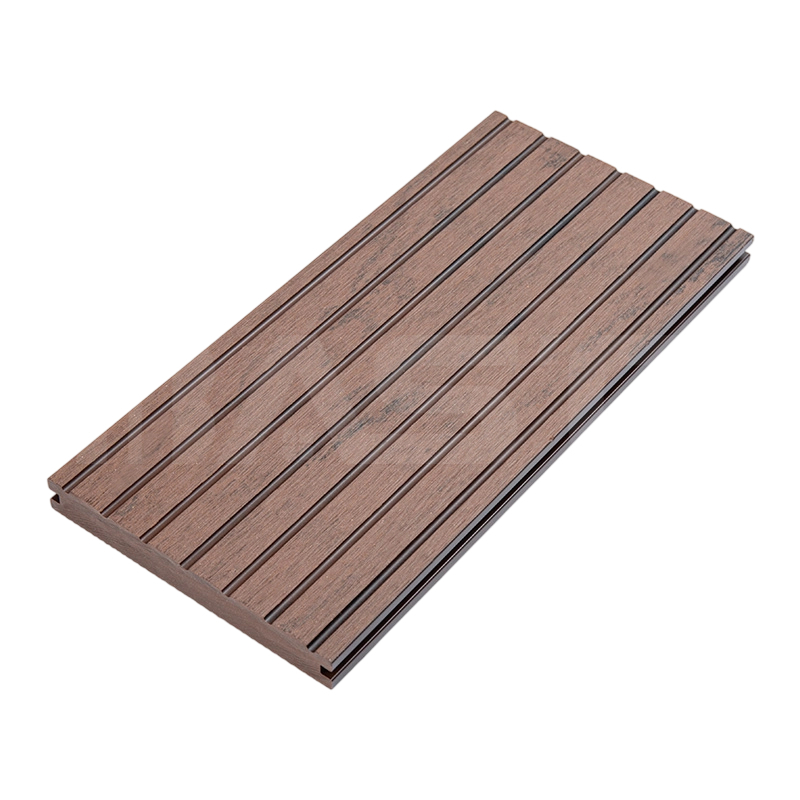
Red is not a single color stop — it is a spectrum that can shift a deck’s personality completely. A brick-red board with heavy grain embossing feels rustic and traditional. A smooth, low-gloss crimson reads more contemporary and architectural. The choice between a deep-embossed woodgrain and a sleek, wire-brushed surface also affects how the board handles dirt and foot traffic.
Three distinct red families dominate the market, each pulling best with a specific exterior backdrop:
- Warm orange-red (Swedish Red, Barn Red): works with white, cream, or light-grey siding. The high contrast creates a crisp, clean look.
- Deep maroon / black-cherry red (Lava Rock, Voyager Red): pairs naturally with dark bronze windows, charcoal fascia, and stone veneer. The dark base absorbs light, making the space feel intimate.
- Terracotta / auburn red (Shaded Auburn, Redwood): blends with warm beige, olive, and sand-colored exteriors. These tones feel earthy and Mediterranean.
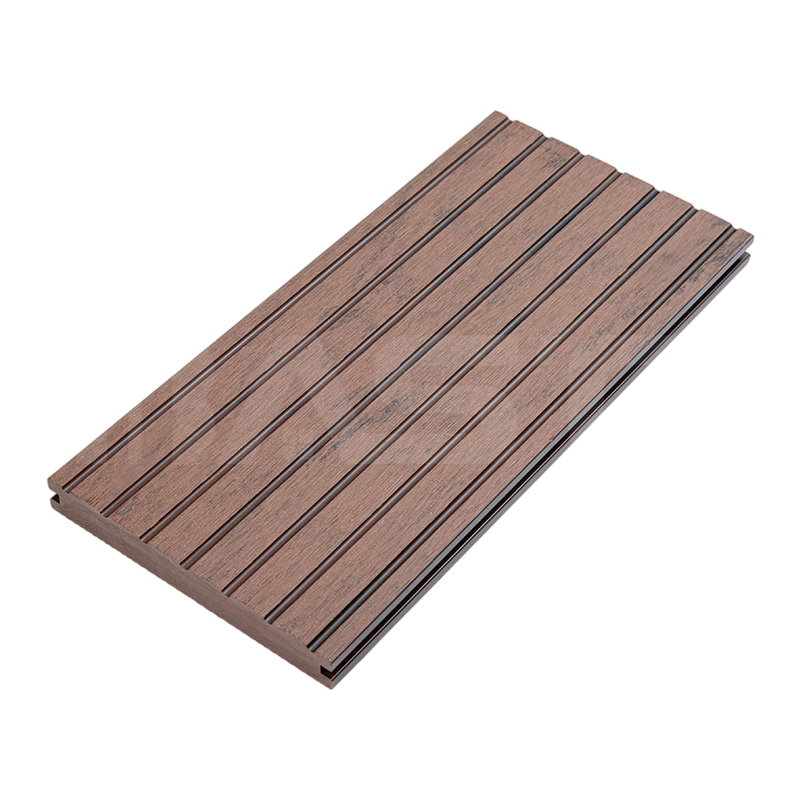
Texture matters as much as tone. Coextruded caps can be engineered with deep embossing that mimics true wood grain, which helps disguise scratches better than a flat surface. A smooth red board may show scuffs from furniture more readily, but it also delivers a clean, low-maintenance appearance that suits modern designs. Always inspect a full 12-inch sample, not just a 2-inch chip, because grain repetition and color variation reveal themselves across the board’s width.
Cost Analysis: Red Composite Decking vs Other Colors
Red composite decking rarely carries a consistent color premium — most brands price all shades within a collection identically. However, premium capped lines like Trex Transcend can edge $0.50-$1.00 per square foot above their mid-tier offerings, regardless of color. The real cost drivers are the board profile (solid vs scalloped), the fastening system (face screws vs hidden clips), and regional labor rates.
| Cost Item | Low Estimate | High Estimate |
|---|---|---|
| Deck boards (100 sq. ft. @ $7-$9) | $700 | $900 |
| Hidden clips & screws | $160 | $250 |
| Labor (100 sq. ft. @ $8-$12) | $800 | $1,200 |
| Total project cost | $1,660 | $2,350 |
DIYers who can install their own decking can drop the labor expense entirely, though red boards demand extra care during cutting and handling to avoid visible edge chips. For bigger decks, some suppliers offer bulk pricing that shaves 10-15% off the per-square-foot cost. If the design uses a picture-frame border in a different color, factor in about 15% more material for miter cuts and waste.
Red is not necessarily more expensive to maintain, but using budget cleaning methods — like high-pressure power washing — can prematurely etch the surface and dull the color faster than on a grey board. Stick to low-pressure rinsing and soft-bristle brushes to preserve the mill finish.
Installation Tips for Red Composite Deck Boards
Installing red deck boards follows the same fundamentals as any composite line, but the color amplifies a few key details. Red pigment makes fine sawdust and chalky cut marks painfully obvious, and uneven spacing stands out against the darker surface. Veteran installers treat red boards like a dark hardwood floor: precision matters, and touch-up time should be built into the schedule.
Five practices that keep a red deck job clean and crack-free:
- Cut boards face-down. Any tear-out or chipping from the saw blade occurs on the exit side of the cut. Placing the visible surface against the table saw bed keeps the good side intact and reduces edge sanding.
- Use hidden clip systems exclusively. Face screws interrupt the color plane and collect grime. Deep-embossed composite decking with a hidden-clip design keeps the surface uninterrupted and eliminates rust stains from fasteners.
- Respect expansion gaps religiously. Temperature swings can push red boards against each other and create visible buckling. Follow the manufacturer’s gap schedule — typically 1/4 inch per 12 feet of run — and use spacer tabs consistently.
- Clean cutting debris immediately. Red dust from a saw dulls the surface if left overnight or walked on. Keep a cordless blower or soft dry rag on hand and remove dust from every joist bay as you go.
- Verify color in full sun before locking boards. A board that looks perfectly uniform in warehouse lighting can reveal stark dye lots when laid out in direct sunlight. Dry-lay several rows, step back, and check the overall color balance before fastening anything permanently.
Miter joints on picture-frame borders introduce another layer of complexity: red boards with a distinct grain direction will catch the light differently on perpendicular cuts. Pre-assembling the border section as a complete frame before setting it into the field can prevent jarring visual shifts.
Long-Term Performance: Fade Resistance and Maintenance
All composite decking fades — the question is how much, and how quickly. Red boards, rich in organic-feeling pigment, tend to show early color shift more than neutral greys. Independent lab tests using ASTM D-2565 xenon-arc exposure indicate that uncapped first-generation composites can lose 8-12 Delta E units within 2,000 hours, while modern coextruded boards with a full polymer cap typically stay under 4 Delta E. That difference translates to a board that lightens just perceptibly over a decade, versus one that turns chalky and uneven after two summers.
| Board Type | Approx. ΔE (color change) | Visual Effect |
|---|---|---|
| First-generation (uncapped) red | 8-12 | Noticeable lightening, patchy in high-traffic zones |
| Capped composite red (standard) | 3-6 | Even, gradual lightening, retains richness |
| Full-wrap coextruded red (BOSO, premium lines) | 1.5-4 | Minimal change, color stays deep beyond 10 years |
Coextruded red boards greatly reduce long-term color loss because the UV stabilizers live inside a thick outer shell that does not abrade easily. That shell also keeps the red pigment from oxidizing when exposed to moisture, a secondary fading trigger common in humid climates.
Maintenance stays simple: wash the surface twice a year with mild liquid soap and a soft brush. Avoid oxygen bleach on red boards unless the manufacturer explicitly approves it — strong oxidizers can create a whitish haze on dark caps. For stubborn sap or grease spots, use warm water and a non-abrasive pad immediately; the longer a stain sits on red, the more likely it is to leave a permanent ghost mark.
Where to Buy Red Composite Deck Boards
Red composite deck boards sell through four main channels, each with distinct trade-offs in availability, sample access, and price control. Selecting the right source hinges on whether you need a standard color off the shelf, a custom shade that matches a historic home, or volume pricing for a commercial project.
- Big-box retailers (Home Depot, Lowe’s): Stock a handful of red shades, offer sample boards in-store or via ship-to-store, and often run seasonal promotions. Downside: limited color selection and no custom tinting.
- Brand company websites: Trex, Deckorators, and Fiberon sell direct or through certified dealers. You can order full color sample kits and access the complete line card. Turnaround times may stretch to 2-4 weeks for less common shades.
- Online composite specialty stores: Suppliers like Composite Deck Direct deliver direct to job sites and sometimes undercut retail by 10-20%. Verify the return policy — red boards that arrive with noticeable batch variation can be harder to exchange.
- Direct from OEM manufacturers (BOSO Composite): When an exact red is non-negotiable, working with the factory unlocks color matching, custom embossing, and private-label sourcing. Minimum order quantities apply, but the per-unit cost often drops below retail once the project exceeds 500 sq. ft.
Before purchasing, request a physical sample — not just a digital rendering — and hold it against your exterior wall, stonework, and outdoor furniture under natural light. If the stock shades feel close but not perfect, an OEM partner can formulate a red that bridges the gap, producing a deck that looks like it was selected, not settled for.
Our News //
Related News
-
Email: [email protected]
Email: [email protected] -
Tel: +86 13732382108
Tel: +86 18705821696 -
 BLDG#1, LONGOUANWU ECO-INDUSTRIALPARK, MIAOXITOWN, WUXINGDISTRICT. HUZHOU. CHINA

Quick Links
Products Center
Copyright © 2025 Huzhou Baosheng New Material Co., Ltd.All Rights Reserved. Composite Decking Manufacturers Composite Cladding Factory
